
Let me start with a number that will make you uncomfortable: 15%
That's the percentage of your take-home pay that should go toward all car expenses. Not the payment. Not the loan. Everything—payment, insurance, gas, maintenance, registration.
If you're a single person with roommates, you can stretch that. If you have a mortgage and two kids? You don't stretch it. You stay under it. Or you become the person I see crying in the finance office three years later.
I've watched too many parents walk into a dealership with a family budget and walk out with a car payment that slowly strangles them. Not because they're bad with money. Because no one gave them a real number before they started shopping.
So here's the real number. And how to make it work.
Step One: Find Your Real Monthly Number
Take your household take-home pay. Not gross. The number that actually hits your bank account every month.
Let's say it's $6,000 after taxes, health insurance, and retirement contributions.
Multiply by 0.15. That's $900.
That $900 is your absolute max for everything car-related. Payment, insurance, gas, oil changes, tires, repairs, registration. Every single dollar that leaves your pocket because you own a car.
Not just the payment. Everything.
Step Two: Back Into a Payment
Here's what comes out of that $900 before you get to a payment:
Expense | Monthly Estimate |
|---|---|
Insurance (two cars, good coverage) | $150 |
Gas (commute + kid hauling) | $150 |
Maintenance/Oil/Tires (averaged) | $75 |
Registration/Inspection (averaged) | $25 |
Total before payment | $400 |
That leaves 500 per month for an actual car payment. Not500permonth∗∗foranactualcarpayment.Not600. Not $700. Five hundred dollars.
That's your real number. Not what the dealer says you qualify for. What your family can actually live with.
Step Three: What That Payment Actually Buys You
Let me run the math for you.
$500/month at 6% interest:
Loan Term | Total Loan Amount | Car Price Range (with $2k down) |
|---|---|---|
60 months | $25,900 | 26,000-26,000−27,000 |
72 months | $30,400 | 30,000-30,000−31,000 |
You can afford a 27,000 car on a 5-year loan. Or a27,000carona5−yearloan.Ora30,000 car on a 6-year loan.
Here's what that gets you in 2026:
New: Honda Civic, Subaru Impreza, base Mazda CX-30, Toyota Corolla Cross
Used (2-3 years old): Honda CR-V, Toyota RAV4, Mazda CX-5, Subaru Outback
Notice what's not on that list? Three-row SUVs. Trucks. Anything with a luxury badge.
You don't need those. You want them. And wanting something isn't a budget.
Step Four: The Kid Reality Check
Kids are expensive. You already know this. But let me remind you what else costs money besides a car payment:
Daycare or after-school care: 800-800−1,500/month
Groceries for four: 600-600−900/month
Kid activities (soccer, dance, music): 100-100−300/month
Clothes, shoes, school supplies: 100-100−200/month
Braces? Summer camp? College savings?
Every dollar you put into a car payment is a dollar you can't put into any of those things.
I'm not saying you should drive a beater. I'm saying the difference between a 500 payment and a500paymentanda700 payment is $2,400 per year. That's summer camp and braces and a weekend trip to the beach.
Which would your kids rather have?
Step Five: The 10/5/3 Rule I Actually Believe In
There's a famous car-buying rule called 20/4/10. Put 20% down, finance for 4 years, keep total car expenses under 10% of gross income.
That's fine for single people. For parents with a mortgage? I use something I call the 10/5/3 Rule:
10% down (minimum, more if you can)
5 years max (60 months, no exceptions)
3% of your take-home for maintenance (that $75/month we already budgeted)
Stick to these three numbers and you won't end up in the finance office crying.
The Harsh Truth
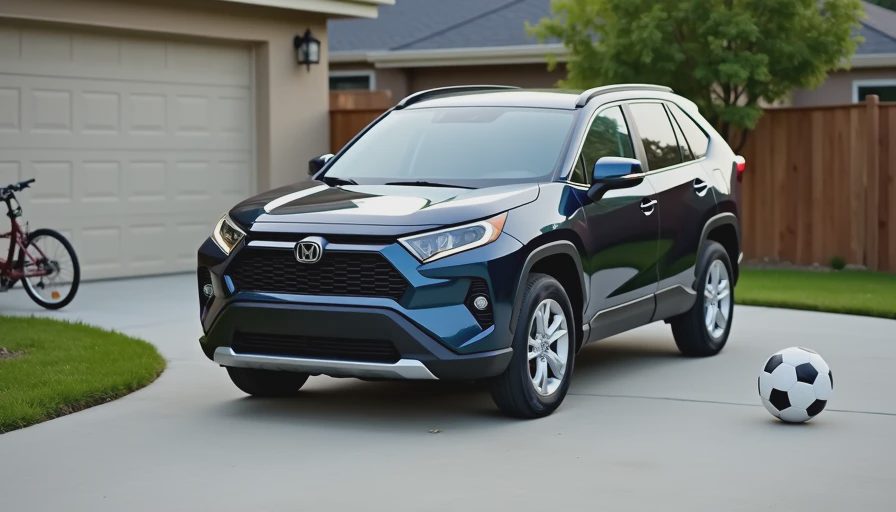
If you have a mortgage and two kids, you probably can't afford the car the dealership wants to sell you.
They'll run your credit and come back with a "pre-approval" for $40,000. Because the bank says you qualify for that payment based on your income and debt.
The bank doesn't care if you have to skip your kid's soccer registration or eat out less or stop saving for college. The bank just wants to get paid.
You have to care.
So here's your homework before you step on a lot:
Calculate your 15% number
Subtract insurance, gas, maintenance, registration
Use a loan calculator to find your maximum car price
Write that number down. Don't go over it.
It's not complicated. It's just uncomfortable.
But being uncomfortable for ten minutes at your kitchen table is better than being broke for five years in a car you couldn't afford.
If the deal sounds clean, look for where they buried the dirt.