
My son, Eli, is eight years old. He loves cars with loud colors, big wheels, and exhaust tips that look like they belong on a spaceship.
Every time we walk through a parking lot, he points. "Dad, that one. Look at that one. Why don't we have that one?"
He doesn't care about reliability ratings. He doesn't understand depreciation. He sees shiny. He wants shiny.
And honestly? Most adults aren't much different.
We just have better excuses.
Here's how I explain bad deals to an eight-year-old. You might be surprised how well it works for grown-ups too.
The Gumball Machine Rule
I took Eli to a grocery store once with one of those big gumball machines by the door. Fifty cents. You turn the dial. A gumball comes out.
He wanted the purple one. Could see it right against the glass. Turned the dial. Got a red one instead.
He was disappointed. Almost cried.
I said: "You paid fifty cents. You got a gumball. The color doesn't change what it is. It's still sugar. It's still round. You're still going to chew it for thirty seconds and ask for another one."
He ate the red one. It was fine.
The lesson: Shiny is just decoration. What matters is what something actually does for you.
I tell Eli: A blue car and a gray car that are the same model, same year, same miles? They're the same car. The blue one isn't faster. It doesn't get better gas mileage. It won't break less. You're just paying extra for the color.
And color doesn't get you to practice on time.
The "Want vs. Need" Talk
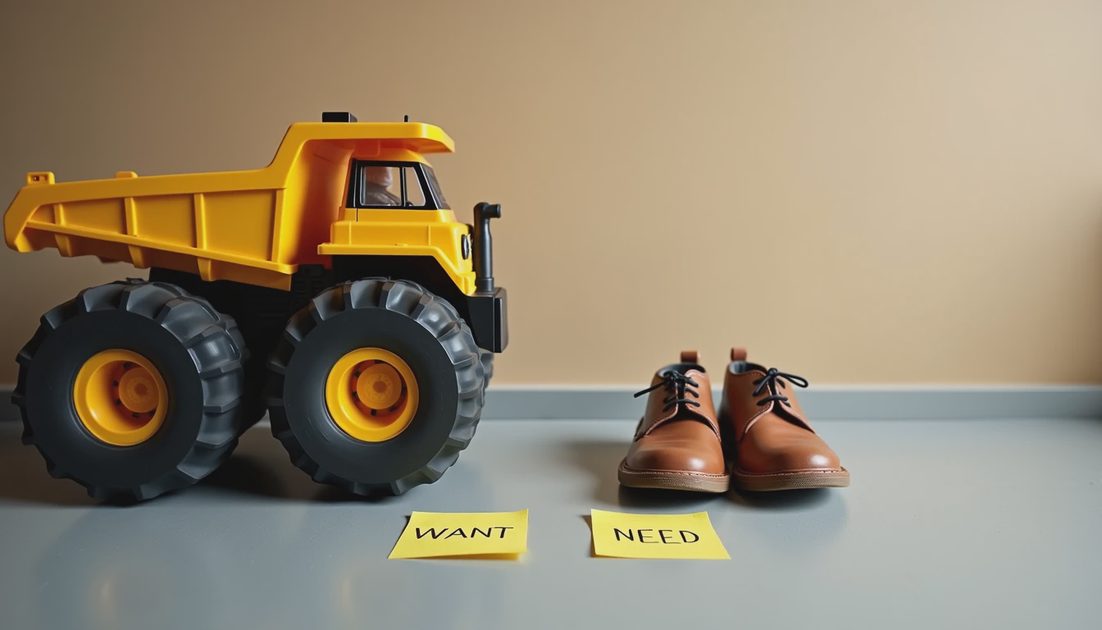
Eli wanted a remote control truck with giant tires. It was $80. It looked cool on the box.
I asked him: "Do you need it? Or do you just want it?"
He thought about it. "Want."
"Okay. What's the difference?"
He didn't have an answer. So I gave him mine.
"Need means you can't do something important without it. You need shoes because your feet would hurt walking to school. You need a jacket because you'd be cold at the bus stop. You don't need a remote control truck. You just think it would be fun."
The lesson: Adults do the same thing with cars. You don't need leather seats. You want them. You don't need a sunroof. You want one. You don't need a V6. You want to feel like you could merge faster, even though you drive the speed limit.
Needs are few. Wants are many. And wants are where bad deals live.
The "How Long Will You Like It" Question
Eli wanted a pair of light-up sneakers. They were expensive. They lit up red and blue when he walked.
I asked: "How long will you like these?"
"Forever!"
"Really? Because last month you had to have the dinosaur shirt. And now you won't wear it."
He got quiet.
"Okay, maybe a few months."
The lesson: The new car feeling wears off. Always. The first week, you're excited. The first month, you show your friends. By month six, it's just the car. And you're still making payments on that feeling that already left.
I tell Eli: Buy things that will still be good after you stop being excited about them. A car that starts every day. A pair of shoes that doesn't hurt your feet. A toy that's still fun next month.
Shiny wears off. Reliable doesn't.
What Eli Teaches Me
Every time I explain this to my son, I realize I'm really talking to myself.
I've made dumb car decisions. Bought the shiny one. Ignored the boring one. Paid for the feeling instead of the function.
Eli doesn't know it, but he's made me a better car buyer. Because he asks the simple questions I forget to ask:
Do you need it or just want it?
What are you giving up to buy it?
How long will you actually like it?
Maybe you need an eight-year-old in your head too.
Next time you're at a dealership, staring at a car with big wheels and metallic paint, ask yourself what Eli would say.